
Compressed Air Dryer Supplier, Dealer & Distributor
Syndicate Industrial Services supplies Trident Pneumatics refrigerated and desiccant compressed air dryers to industrial plants in Lucknow, Kanpur, Gorakhpur and other serviceable industrial locations across Uttar Pradesh. A dryer removes the water vapour that compressed air carries, protecting pneumatic equipment, pipework and products from moisture, corrosion and spoilage. We help you choose a dryer from your air flow, pressure, temperature and required dew point, and support it with installation and maintenance services.
- 6 dryer ranges
- Since 2001 in Lucknow
- 4 locations Lucknow, Kanpur, Gorakhpur, Varanasi
- Trident Pneumatics range
Industrial Compressed Air Dryer Solutions
Six Trident Pneumatics dryer ranges: refrigerated, heatless desiccant, heated desiccant, custom-engineered and breathing air. Select a range to see its models and specifications, or request a quotation and we will suggest the dryer that suits your system.
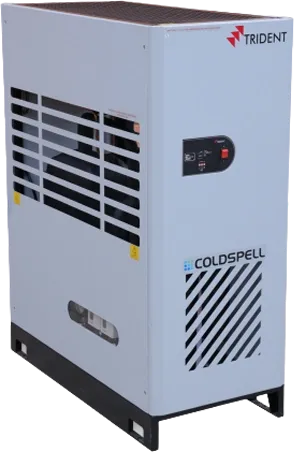
Coldspell Refrigeration Compressed Air Dryers
Refrigerated dryers that cool the air to condense and remove moisture, preventing condensation and corrosion in the system. All-aluminium heat exchanger with built-in moisture separator. 20 to 2000 scfm.
View details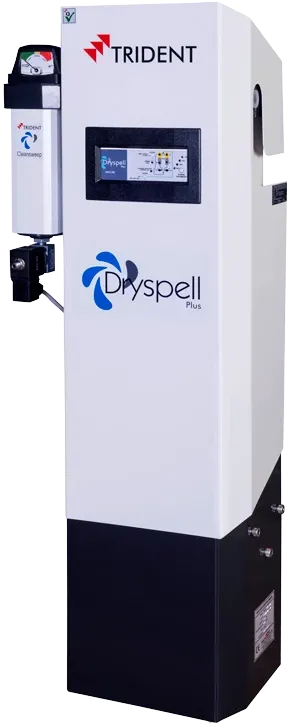
Heatless Desiccant Air Dryers
Dryspell Plus heatless desiccant dryers for pressure dew points up to -40 °C, in corrosion-free aluminium construction with a dew point based control option. 10 to 375 scfm.
View details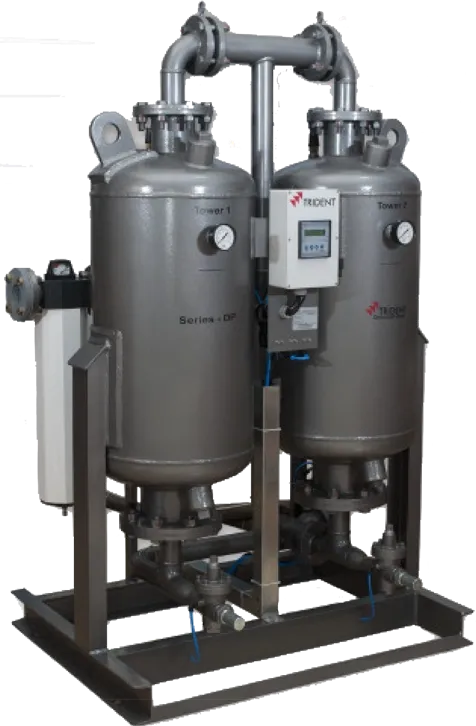
Compressed Air Dryers DP Series
Heatless desiccant dryers for precision machines that need a low pressure dew point, rated to ISO 8573-1 class 3 (-40 °C ADP) with a built-in 1 micron after-filter. 450 to 1130 cfm.
View details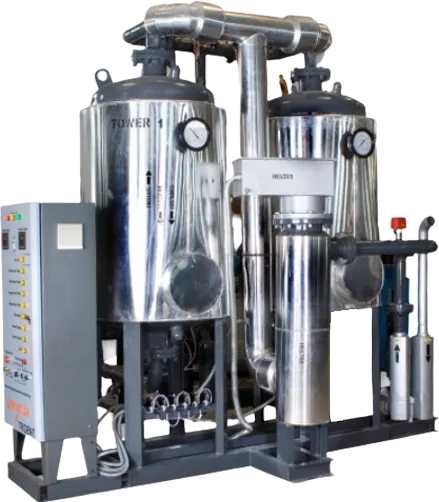
Heated Desiccant Air Dryers
Heat-regenerated adsorption dryers, including blower heat reactivated types, for large air flows and dew points below -20 °C, with dew point based tower changeover.
View details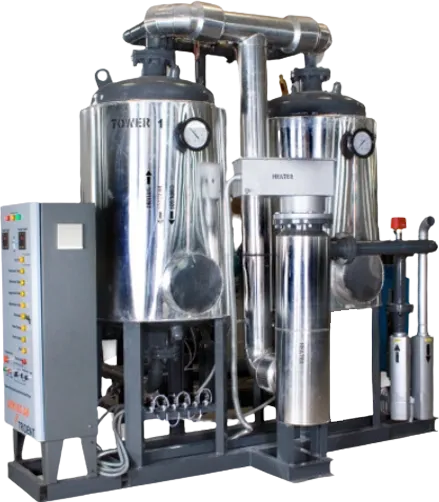
Custom Solutions
Engineered dryer packages to customer and consultant specifications, including heated, heat of compression and split-flow dryers and high-pressure or intermittent-duty dryers for OEM needs.
View details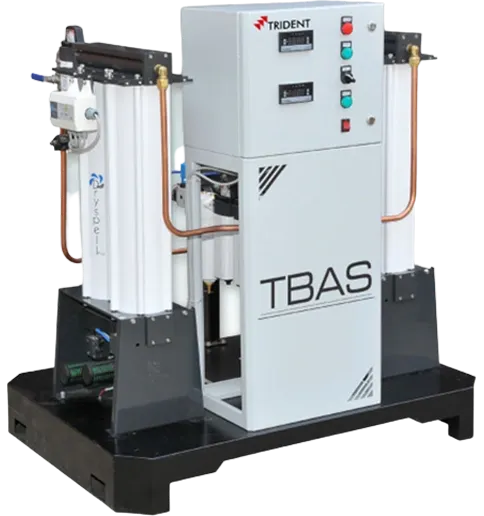
Trident Breathing Air System
TBAS breathing air system built around a desiccant dryer, with coalescing pre-filter, particulate fine filter, activated carbon filter and bacterial filter, and carbon monoxide and dew point alarms.
View detailsWhat Is an Industrial Compressed Air Dryer and Why Is It Important?
A compressed air dryer removes water vapour from compressed air so that moisture does not condense in the pipes and machines downstream. It lowers the dew point of the air, which is the temperature at which water would start to form.
Moisture enters the system with the air itself. Atmospheric air always carries water vapour, and the compressor draws in a large volume of it and squeezes it into a small one, so the compressed air leaves the compressor fully saturated. As it cools in the aftercooler, receiver and pipework, the vapour turns to liquid. The amount rises quickly with temperature: warm, humid air brings in far more water than cool, dry air.
Left in the network, that water rusts receivers and pipes, washes lubricant out of cylinders and valves, freezes in cold or outdoor lines, and carries scale and dirt that block small orifices. For pneumatic equipment this means faster wear and unreliable operation, and for production it means spoiled paint, damaged products or contaminated packaging. How dry the air must be depends on the process: general tool air tolerates more than instrument air, paint spraying, or air that touches food, medicines or electronics. Choosing a dryer that gives the dew point the application needs, without over-drying, protects the process and keeps energy use sensible.
How to Choose the Right Compressed Air Dryer for Your Industrial Application?
Choose a dryer from the air flow and the dew point the process needs, then check the inlet and ambient temperatures against the dryer's rated conditions. The main technologies compare as follows:
| Dryer type | How it dries | Dew point | Suited to |
|---|---|---|---|
| Refrigerated | Cools the air so water vapour condenses into liquid, which is separated and drained. | Limited to above freezing, because the water would freeze in the heat exchanger. | General plant air, tools and machinery where a dew point just above freezing is enough. |
| Heatless desiccant | Passes the air through a desiccant bed that adsorbs water vapour. A small portion of the dried air is used to regenerate the other bed. | Published up to -40 °C pressure dew point on our Dryspell Plus and DP Series pages. | Precision machines, instruments and processes that need a low dew point, and air lines exposed to cold. |
| Heated desiccant | Adsorbs on a desiccant bed like a heatless dryer, but regenerates the bed with heated air, as in the blower heat reactivated thermal swing type. | Published below -20 °C, suited to large air flows. | Large air volumes where regeneration energy matters, such as the cement, power and fertiliser plants listed on our heated dryer page. |
Dew point figures are those published on our heatless, DP Series and heated desiccant product pages. Refrigerated dryers are covered on the Coldspell page.
These are the factors we ask about before recommending a model:
| Factor | What to establish |
|---|---|
| Required compressed air flow | The air the dryer must handle, in scfm or m³/min, taken from the compressor output or the plant demand. Dryer models are rated by flow, so the next size up from your peak flow is chosen. |
| Operating pressure | The line pressure at the dryer inlet, in bar or kg/cm². Dryer ratings are given at stated conditions, and the pressure affects both capacity and the check of the housing and vessels. |
| Inlet air temperature | Hotter air carries much more water vapour, so the moisture load rises quickly with temperature. Our dryer ratings are given at nominal inlet conditions (ISO 7183), and the capacity falls when the actual inlet is warmer. |
| Ambient temperature | A refrigerated dryer rejects heat to the surrounding air, so a hot compressor room reduces its capacity. A large condenser helps at high ambient temperatures. |
| Required pressure dew point | The temperature at which the air starts to condense at line pressure. Set it from the lowest temperature the air will meet and the process need, with a margin, rather than from the dryer type. |
| Air quality requirements | ISO 8573-1 gives purity classes for water, oil and particles. A published dryer class covers water only, so oil and dust are handled by filters before and after the dryer. |
| Moisture load | Set by air flow, inlet temperature and pressure. Heavy loads call for a pre-filter, a moisture separator and a drain ahead of the dryer. |
| Operating environment | Outdoor or cold locations, dust, humidity and altitude affect the choice, as does available space. Pipes exposed to freezing need a dew point below the lowest temperature. |
| Energy consumption | Refrigerated dryers draw electrical power. Heatless desiccant dryers use a share of the dried air to regenerate, and heated dryers use heater or blower energy. Compare running cost over the life of the dryer, not only price. |
| Existing system configuration | Where the dryer sits relative to the compressor, receiver and filters, plus connection size and electrical supply. The dryer pages list recommended pre-filters and after-filters for each model. |
Where the process is unusual, for example very high pressure, intermittent duty or OEM equipment, our custom solutions engineers dryer packages to specification. For breathing air requirements, see the Trident Breathing Air System.
How Does an Industrial Compressed Air Dryer Work?
A dryer either condenses the water out by cooling the air, or adsorbs it onto a desiccant bed. The two methods work on different principles, so they are described separately.
Refrigerated dryers: cooling and condensation
The compressed air passes through a heat exchanger and is cooled to just above freezing by a refrigeration circuit. At this temperature most of the water vapour condenses into liquid. A built-in moisture separator collects the droplets and an automatic drain removes the condensate. The cold air then passes back through the air-to-air heat exchanger, where the incoming warm air reheats it, so the outgoing air is drier and does not form condensation on the outside of pipes. The dew point cannot go below freezing, because the condensate would freeze inside the heat exchanger.
Desiccant dryers: adsorption
Wet air first passes a coalescing pre-filter, where oil and liquid water are removed and drained. The air then flows through a tower filled with desiccant, such as activated alumina or molecular sieve, which adsorbs the water vapour onto its surface. A built-in after-filter removes desiccant dust before the air leaves. Two towers work in turn: while one dries the air, the other is regenerated, so the supply is continuous.
- Heatless regeneration. The tower is depressurised and a small part of the dried air is passed over the desiccant, which carries off the water. This is how the Dryspell Plus and DP Series dryers work.
- Heated regeneration. The bed is heated, as in the blower heat reactivated type, which works on a thermal swing between the compressed air temperature and the regeneration temperature, so the bed gives up its moisture to a hot air stream. See heated desiccant air dryers.
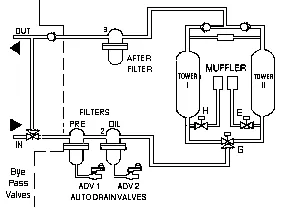
Pressure dew point is the measure of dryness in both cases. Filters and drains around the dryer, covered under compressed air filters and drains, complete the treatment.
Where Are Compressed Air Dryers Used?
Dryers are used wherever compressed air is a utility and moisture can do harm. The rows below are general compressed-air uses. The applications Trident Pneumatics lists for each dryer are on the product pages, and the dew point each application needs differs widely, which we review before recommending equipment.
Automotive manufacturing
Paint shops, assembly tools and robotic cells need dry air, so finishes are not spoiled and valves and cylinders do not corrode. Compressed air for the automobile industry.
Engineering industries
CNC machines, coating and blasting equipment last longer on dry air, and wet air in tools leads to rust and wear. Compressed air for engineering and fabrication.
Pharmaceutical manufacturing
Moisture in air that reaches products, packaging or instruments is controlled to the plant's quality requirement, usually with a desiccant dryer and filters. Compressed air for pharmaceutical plants.
Food processing
Air that conveys, fills or packs food must be dry, and is treated to the plant's food safety requirement. Compressed air for food and beverage plants.
Packaging industries
Fast-cycling filling, sealing and labelling machines need dry air to keep pneumatic valves and cylinders working. Compressed air for the packaging industry.
Textile manufacturing
Moisture in air-jet looms and spinning lines can mark yarn and fabric, and corrode machine parts. Compressed air for textile mills.
Chemical industries
Instrument air and process air must be dry and continuous, and a low dew point protects lines and instruments. Compressed air and nitrogen for chemical plants.
General industrial production
Plastics, paper, steel, cement, power and fertiliser plants use dried compressed air for actuation, conveying and instrument air. Browse all industries we serve.
Complete Compressed Air Treatment Solutions for Industrial Systems
A dryer works best as one part of a treatment line: separation, drainage, filtration and drying, matched to the compressor. A rotary screw air compressor produces the air. A moisture separator and an automatic drain, such as the level-sensing LDV drain valve, remove liquid water. A coalescing pre-filter takes out oil and liquid, the dryer lowers the dew point, and an after-filter catches dust. Our dryer pages list the pre-filters and after-filters recommended for each model, and the full range is on our compressed air filters and drains page.
Getting the air quality right also depends on the system around the dryer: piping, receiver size, and the quality class the process needs. Our guide to compressed air treatment and our compressed air solutions cover this, and the other Trident ranges are on the Trident Pneumatics page. We support the dryer from selection onward:
- Equipment selection assistance. We match the dryer type and size to your air flow, pressure, temperature and dew point requirement, as part of Compressed Air Solutions.
- Installation and commissioning. Installation, commissioning and testing, up to complete turnkey delivery, through Turnkey Projects.
- Preventive maintenance and technical support. Scheduled servicing, health checks and spare parts support under AMC Services.
Compressed Air Dryer Supplier Across Uttar Pradesh
Syndicate Industrial Services works as a compressed air dryer supplier from its head office in Lucknow, and as an industrial air dryer dealer through its branches in Kanpur and Gorakhpur, with a further branch in Varanasi. Beyond these cities we deliver compressed air treatment solutions to plants across Uttar Pradesh, as our project record and project map show. Service availability depends on operational coverage and project requirements, so send us your plant location and we will confirm how we can support it.
Why Choose Syndicate Industrial Services for Compressed Air Dryers?
- In business since 2001. Syndicate Industrial Services began operations in Lucknow in 2001 and serves industrial customers across Uttar Pradesh.
- Refrigerated and desiccant dryers. Six Trident Pneumatics ranges on this page, from refrigerated and heatless desiccant to heated and custom-engineered dryers.
- One supplier for the whole air system. Compressors, dryers, filters, drains, aluminium piping and pneumatic components from Deep Pneumatics, Trident, Quickair and Janatics.
- Selection based on your numbers. We ask for air flow, pressure, temperatures and the dew point you need before recommending a dryer.
- Installation to maintenance under one roof. Installation, commissioning and annual maintenance contracts are offered by the same team.
- Branch network. Operations and customer support run through Lucknow (head office), Kanpur, Gorakhpur and Varanasi.
Frequently Asked Questions About Industrial Compressed Air Dryers
01What is an industrial compressed air dryer?
An industrial compressed air dryer is equipment installed after the compressor that removes water vapour from compressed air, so moisture does not condense in the pipes and machines downstream. The main types are refrigerated dryers, and desiccant dryers, which can be heatless or heated.
02Why is a compressed air dryer required in industrial applications?
Compressed air leaves the compressor saturated with water vapour. As it cools in the pipes, the vapour condenses and causes corrosion, wear, frozen lines, blocked valves and spoiled products. A dryer lowers the dew point of the air so condensation does not occur at the temperatures the system sees.
03How does a refrigerated air dryer work?
A refrigerated air dryer cools the compressed air to just above freezing in a heat exchanger. The water vapour condenses into liquid, a separator collects it, and a drain removes it. The cold air is then warmed by the incoming air before it leaves, so it does not sweat on the pipes.
04What is a desiccant air dryer?
A desiccant air dryer passes compressed air through a bed of adsorbent such as activated alumina or molecular sieve, which holds the water vapour on its surface. Two beds work in turn: one dries the air while the other is regenerated. It reaches a lower dew point than a refrigerated dryer.
05What is the difference between refrigerated and desiccant air dryers?
A refrigerated dryer condenses water by cooling, so its dew point stays above freezing. A desiccant dryer adsorbs water on a bed and can reach well below freezing, for instance -40 °C on our heatless ranges. Desiccant dryers use regeneration energy, while refrigerated dryers use electrical power for cooling.
06How do I select the right capacity of an air dryer?
Take the peak air flow in scfm or m³/min, then check it against the dryer's rating at your inlet temperature, pressure and ambient temperature, since ratings are stated at nominal conditions. Choose the required dew point, then the next size up. Send us these figures and we will recommend a model.
07What is pressure dew point in a compressed air system?
Pressure dew point is the temperature at which the air at line pressure is fully saturated and water starts to condense. A lower figure means drier air. For example, air at -40 °C pressure dew point will not condense water unless the air gets colder than -40 °C.
08Why is moisture removal important for pneumatic equipment?
Water in compressed air washes lubricant out of cylinders and valves, rusts parts, freezes in cold lines, and carries dirt that blocks small orifices. This shortens equipment life and causes erratic operation. Removing moisture with a dryer, backed by filters and drains, protects pneumatic tools and automation.
09Can an air dryer be used with an industrial air compressor?
Yes. A dryer is normally installed after the compressor, its aftercooler and receiver, and usually after a coalescing pre-filter that removes oil and liquid water. An after-filter follows a desiccant dryer to catch dust. Our dryer pages list the pre-filter and post-filter recommended for each model.
10Where can I find a compressed air dryer supplier in Uttar Pradesh?
Syndicate Industrial Services supplies Trident Pneumatics refrigerated and desiccant compressed air dryers from its head office in Lucknow, with branches in Kanpur, Gorakhpur and Varanasi. Use the enquiry form on this page or call +91 93350 37579 to confirm availability for your location.
Looking for an Industrial Compressed Air Dryer?
Tell us about your system: the air flow and pressure, the inlet and ambient temperatures, and the dew point your process needs. We will review it and recommend a suitable dryer with a quotation.