
Managing wastewater is no longer just a regulatory requirement. It has become a critical part of sustainable business operations.
However, not all wastewater is the same. Production-process water may contain chemicals, oils, metals, and other pollutants, while water from toilets, kitchens, and washrooms mainly contains organic waste and microorganisms.
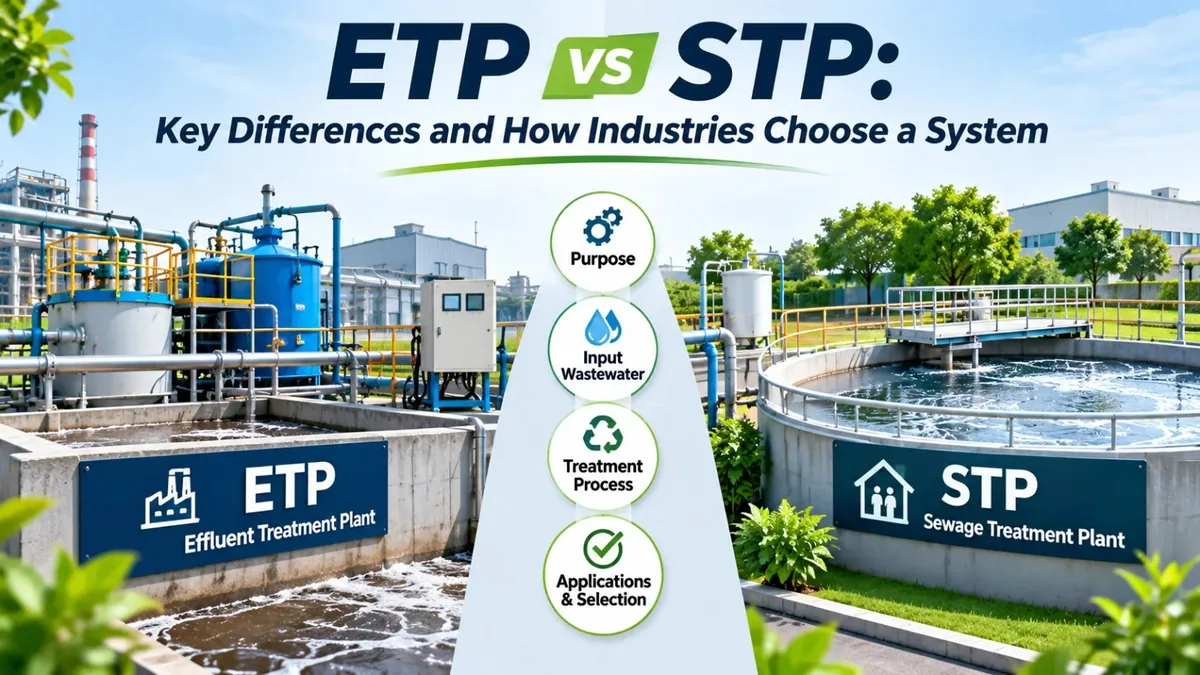
Even in 2026, many businesses still struggle to understand the difference between an Effluent Treatment Plant (ETP) and a Sewage Treatment Plant (STP). While both systems treat wastewater, they serve different purposes and are built to handle distinct types of contaminants.
In today’s blog guide, we explain ETP vs STP, how each system works and explain how to help industries to choose the right treatment system for their specific needs. Let us begin.
- 01 What Is an Effluent Treatment Plant (ETP)?
- 02 What Is a Sewage Treatment Plant (STP)?
- 03 ETP vs STP: What Is the Main Difference?
- 04 Key Factors That Influence Wastewater Treatment Plant Design
- 05 ETP vs STP: A Checklist for Selecting the Right System
- 06 Why the Right Treatment System Is About More Than Compliance
- 07 How to Select the Right Supplier?
- 08 Choose the Right Wastewater Treatment System for Your Facility
1. What Is an Effluent Treatment Plant (ETP)?
An effluent treatment plant for industry is designed to treat wastewater generated from industrial operations. This wastewater, commonly called industrial effluent, often contains chemicals, oils, heavy metals, toxins, suspended solids, and other pollutants that cannot be discharged directly into the environment.
Different industries produce different types of wastewater. For example, a textile factory may release wastewater containing dyes and harsh chemicals, while a metal finishing unit may produce wastewater containing metals. Each type needs the right treatment approach.
Because industrial waste is unpredictable, an effluent treatment plant for industry uses different treatment methods to handle it effectively. These may include physical processes to remove solid particles, chemical treatments to neutralise harmful substances, and biological processes to break down organic waste.
These processes help remove impurities, control pH levels, and break down harmful substances. Overall, the aim is to make the treated water safe for discharge or suitable for reuse, depending on the required standards.
2. What Is a Sewage Treatment Plant (STP)?
On the other hand, there is a sewage treatment plant (STP). A sewage treatment plant treats domestic wastewater from toilets, bathrooms, kitchens, laundry areas, and similar sources. This wastewater is commonly generated by homes, apartments, hotels, resorts, hospitals, schools, offices, and commercial complexes.
This wastewater contains human waste, food particles, soaps, and detergents. STPs use biological treatment processes in which microorganisms break down organic waste in the water. Microorganisms naturally consume and break down organic matter in the wastewater.
After treatment, the water may be reused for purposes such as gardening and toilet flushing, or safely discharged, provided it meets the required quality standards. CPCB also encourages industries to reuse and recycle waste wherever applicable.
3. ETP vs STP: What Is the Main Difference?
Both ETPs and STPs are used to treat wastewater, but the type of wastewater they treat is different.
| Parameter | ETP | STP |
|---|---|---|
| Full Form | Effluent Treatment Plant | Sewage Treatment Plant |
| Wastewater Source | Industrial processes | Domestic and sanitary activities |
| Pollutants | Chemicals, oils, metals, toxins | Organic matter, nutrients, bacteria |
| Treatment Complexity | High | Moderate |
| Customisation Level | Highly customised | More standardised |
| Operating Requirements | Industry-specific | Relatively predictable |
| Primary Goal | Industrial wastewater treatment | Sewage treatment and reuse |
In India, discharge requirements may vary by industry, location, consent conditions and disposal method. Businesses should confirm the applicable standards with the relevant State Pollution Control Board or Pollution Control Committee rather than rely on generic treatment specifications.
4. Key Factors That Influence Wastewater Treatment Plant Design
Not all wastewater is the same. The right treatment system depends on where the wastewater comes from, what it contains and how much is generated each day.
The overall design of a wastewater treatment plant depends on the quality, quantity and characteristics of the incoming wastewater.
For example, an industrial facility may produce wastewater containing oils, chemicals or heavy metals, while another may generate water with high levels of organic waste. An effluent treatment plant (ETP) must be designed to handle the specific pollutants present in that wastewater.
Sewage treatment plants (STPs) have different requirements. They mainly treat domestic sewage, but the amount of wastewater entering the plant can change during the day. The system must be able to manage these variations without affecting treatment performance.
Before selecting a system, it is important to check the following:
- Flow volume
- pH levels
- Biological Oxygen Demand (BOD)
- Chemical Oxygen Demand (COD)
- Total Suspended Solids (TSS)
- Oil and grease content
- Heavy metals
- Nutrient concentrations
This information forms the foundation of an effective treatment system.
5. ETP vs STP: A Checklist for Selecting the Right System
A good ETP selection checklist starts with data, not equipment. Collecting the right information early helps you choose a suitable system, control operating costs, and avoid capacity or compliance issues later. Gather these before you speak to any supplier:
- Daily wastewater volume and peak-hour flow
- Source of wastewater: domestic sewage, process effluent, or both
- Physical parameters such as pH, temperature, colour, and odour
- Chemical parameters including BOD, COD, TSS, TDS, oils, nutrients, and metals
- Seasonal variations and batch-production patterns
- Available land, power supply, and drainage arrangements
- Required treated-water quality for discharge or reuse
- Local pollution-control board norms and consent conditions
Getting these details right from the beginning can prevent problems later. A system designed without proper assessment may not perform well and lead to higher operating costs.
6. Why the Right Treatment System Is About More Than Compliance
A water treatment plant is not only a capital purchase; it is an ongoing operational system. It’s a system that will run for years, so look at lifetime cost, not only the upfront price.
Ask how much electricity the plant uses, how many operators are needed, and how often parts such as membranes and other equipment need servicing or replacement.
It is also important to choose a system that is easy to monitor and maintain. Automatic sensors and remote alerts can help detect issues early and reduce the need for regular manual checks.
Before selecting a treatment plant, consider whether the treated water can be used again within your facility or not. Depending on the treatment process and water quality, it can be used for gardening, flushing toilets, cooling systems, and cleaning equipment. This can help reduce freshwater use and make better use of available water resources.
For hotels and resorts, it also supports sustainability goals that today’s guests notice and appreciate. In water-stressed regions, reuse can be as valuable as compliance itself. Moreover, it supports sustainability initiatives, especially in areas where freshwater resources are limited.
7. How to Select the Right Supplier?
Whether you’re choosing an ETP or an STP, a supplier’s answers tell you a lot. Before signing, confirm:
- Experience in your industry. Have they treated similar wastewater before? Ask for site references.
- Design basis. Is the proposal built on your lab data, or on assumptions?
- Guaranteed outlet quality. What parameters are promised, and how are they verified?
- Compliance support. Will they help with consent applications and documentation?
- Operating costs. Ask for estimated power, chemical and manpower costs in writing.
- After-sales service. Is there commissioning support, operator training, and an AMC (annual maintenance contract)?
- Scalability. Can the plant expand if your capacity grows?
At SiS India, we understand that every facility has different wastewater treatment needs. Our team begins with a site assessment and wastewater analysis to understand your requirements and recommend a suitable solution. Whether you need an effluent treatment plant for a manufacturing unit or a sewage treatment plant for a hotel or residential project, we help you choose a system based on your wastewater volume, quality, and reuse needs.
Our support continues even after installation through operator training, maintenance, and performance assistance to help keep your plant running efficiently.
8. Choose the Right Wastewater Treatment System for Your Facility
The choice between an ETP and an STP starts with one simple question: where does your wastewater come from?
If it comes from industrial production processes, an ETP may be required. On the other hand, if it comes from toilets, kitchens and other sanitary facilities, then an STP is generally the appropriate solution.
But if your facility is generating both types of wastewater, then you may need separate treatment systems or develop a carefully customised engineered treatment arrangement based on compatibility and regulatory requirements.
As industries continue to prioritise responsible water management, selecting the right treatment system becomes a decision that benefits both business performance and environmental stewardship.
Thus, working with an experienced wastewater treatment provider can help you assess your wastewater, identify suitable technologies and plan a system around your capacity, site conditions and reuse goals.
Ready to find the right system for your site? Contact SiS India today for a site assessment and explore which wastewater treatment solution supports reliable operation, responsible water management and long-term goals.