
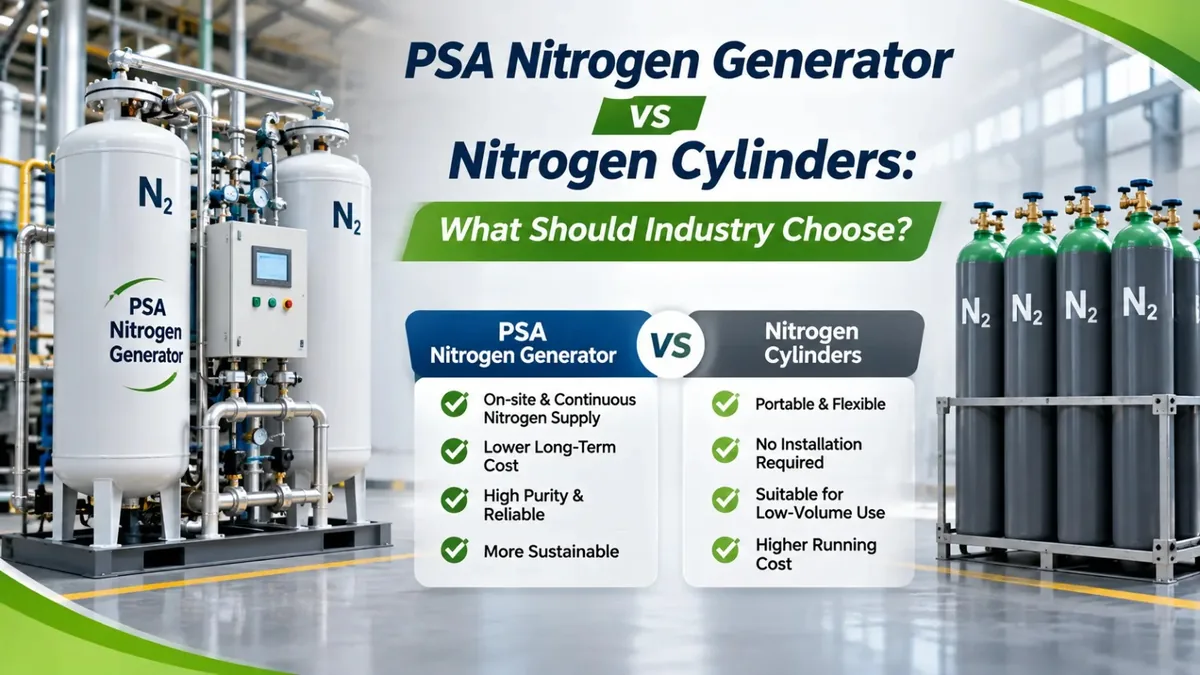
Nitrogen plays a critical role in modern industrial operations. From food packaging and pharmaceuticals to laser cutting, electronics, and manufacturing, a consistent nitrogen supply helps businesses maintain product quality, improve safety, and support efficient production processes.
But while choosing a nitrogen supply system, many businesses still have this one common question in mind: Should they use nitrogen cylinders or install a PSA nitrogen generator?
While nitrogen cylinders have been the traditional solution for decades, they are not the only option anymore. With on-site nitrogen generation, industries can produce nitrogen directly at their facilities instead of relying on regular cylinder deliveries. But is this approach better for every business?
In today’s blog we will look at both the nitrogen gas supply options, comparing them in simple terms so that you can choose the right solution with confidence. Let us begin.
- 01 What Is a PSA Nitrogen Generator?
- 02 Why Are Industries Now Switching to Onsite Nitrogen Generation?
- 03 How Nitrogen Cylinder Supply Actually Works?
- 04 PSA Nitrogen Generator vs Nitrogen Cylinders: Technical Comparison
- 05 Which Industries Can Benefit from Nitrogen Generators?
- 06 Evaluating the Real Cost of Nitrogen Supply
- 07 Questions to Ask a Nitrogen System Supplier
- 08 So, Which One Should the Industry Choose?
1. What Is a PSA Nitrogen Generator?
Around 78% of the air we breathe is nitrogen. Onsite nitrogen generation simply separates it from the rest of the air, and this is all done right inside your facility, so you do not have to depend entirely on gas cylinders for your supply.
A PSA (Pressure Swing Adsorption) nitrogen generator uses compressed air and a special material called a carbon molecular sieve (CMS) to separate nitrogen from other gases. The sieve allows nitrogen to pass through while trapping most of the oxygen.
The system uses two towers that take turns separating the gases and releasing the trapped oxygen. This allows the generator to provide a continuous supply of nitrogen while it is operating.
The system mainly needs compressed air and electricity to work. Since nitrogen is produced directly at your facility, you do not have to arrange regular cylinder deliveries or wait for a refill.
For businesses that need nitrogen regularly, a nitrogen generator for industrial applications can be a convenient way to manage their gas supply.
2. Why Are Industries Now Switching to Onsite Nitrogen Generation?
For businesses that use nitrogen regularly, managing the gas supply can become an ongoing task. They need to keep track of cylinder levels, arrange refills and make sure there is enough gas to support daily operations.
With on-site nitrogen generation, companies can produce nitrogen at their own facilities and manage their supply more directly.
Here are some reasons why industries opt for this approach:
- Continuous nitrogen supply
- Smoother operations
- Simpler inventory management
- Better production planning
- Better control over nitrogen purity levels
- Potential long-term savings
These advantages can help industries simplify daily operations. For industries that need consistent nitrogen demand, these benefits can make on-site generation a convenient way to manage gas supply and improve overall operational efficiency.
3. How Nitrogen Cylinder Supply Actually Works?
Nitrogen cylinders contain compressed nitrogen that is supplied by a gas provider. Once a cylinder is empty, it needs to be replaced with a full one to maintain production.
Nitrogen cylinders are a suitable choice for businesses that use nitrogen occasionally or in small quantities.
This method works well for businesses with occasional nitrogen requirements or lower consumption volumes. But operations that rely heavily on nitrogen daily often need to store additional cylinders and plan for their deliveries well in advance to keep their operations running smoothly.
Managing cylinders involves more than simply purchasing gas. Companies must coordinate deliveries, monitor inventory levels, arrange storage space, and ensure safe handling procedures are followed as per the updated regulatory standards throughout the facility.
As production demand grows, these logistical requirements can become increasingly complex and time-consuming.
4. PSA Nitrogen Generator vs Nitrogen Cylinders: Technical Comparison
Before choosing between a PSA nitrogen generator and nitrogen cylinders, it is important to understand the nitrogen requirements of your application. Factors such as nitrogen purity, volumetric flow rate and delivery pressure are important to consider as they affect the overall gas quality, equipment performance and the reliability of the supply.
| Requirement | PSA Nitrogen Generator | Nitrogen Cylinders |
|---|---|---|
| Nitrogen purity | Can be configured to achieve the required purity, depending on the generator model and operating conditions (95% to 99.9995%). | Available in different purity grades, depending on the supplier and gas specification. |
| Flow rate | Selected based on average consumption, peak demand and required flow capacity, typically measured in Nm³/h or m³/h. | Depends on cylinder capacity, the number of cylinders connected and the manifold's flow capacity. |
| Operating pressure | Supplies nitrogen at the system's rated outlet pressure. A booster compressor may be required for higher-pressure applications. | Nitrogen is stored at high pressure and delivered through pressure regulators. |
| Supply continuity | Can provide a continuous supply when correctly sized and supported by adequate compressed air and power. | Requires sufficient cylinder stock and timely changeovers or replacements. |
| Purity monitoring | Online oxygen analysers can monitor residual oxygen to help verify nitrogen purity. | Purity is generally established through the supplier's gas specifications and quality documentation. |
PSA nitrogen generators are a good choice for industries that need a steady supply of nitrogen with consistent purity, flow rate and pressure. Depending on the system design, online purity analysers and automatic controls can monitor nitrogen quality and divert or stop the gas supply if it does not meet the required specifications.
Nitrogen cylinders, on the other hand, can be practical for short-term projects, pilot plants, maintenance work or facilities without a suitable compressed-air system.
5. Which Industries Can Benefit from Nitrogen Generators?
Onsite nitrogen generation can be useful across a wide range of industries.
Food and beverage processing: Used for modified atmosphere packaging, oxygen displacement and reducing oxidation in packaged foods. The purity level depends on the product and food safety specifications.
Pharmaceuticals and chemical processing: Used for tank blanketing, vessel purging and reactor inerting to limit oxygen exposure and reduce the risk of unwanted reactions.
Electronics manufacturing: In plants, nitrogen is commonly used as a process gas during wave and reflow soldering to minimise oxidation and improve soldering conditions.
Metal fabrication and heat treatment: Nitrogen can provide a protective atmosphere during certain annealing and heat treatment processes. Plus, it is also used in selected brazing applications.
Laser cutting: Nitrogen serves as a high-pressure assist gas for cutting stainless steel and other metals where oxidation-free or low-oxidation edges are important.
Oil, gas and plastics manufacturing: Nitrogen is used here for pipeline purging, equipment inerting and selected plastic moulding processes.
If your plant runs for long hours and nitrogen is part of your daily process, on-site generation is a good choice.
6. Evaluating the Real Cost of Nitrogen Supply
Many businesses initially compare only the purchase price of nitrogen. However, the complete evaluation is based on the total cost of ownership.
Costs Associated with Nitrogen Cylinders
Cylinder-based systems may include:
- Gas purchase costs
- Delivery charges
- Transportation fees
- Rental or cylinder holding charges
- Labour for handling and replacement
- Storage infrastructure
As nitrogen consumption increases, these recurring costs can add up significantly over time.
Costs Associated with PSA Nitrogen Generators
The nitrogen generator for industry requires a higher upfront capital investment. But it can help you in saving your ongoing operating costs. This includes:
- Electricity consumption
- Compressed air generation
- Routine maintenance
- Periodic filter replacement
For many high-consumption facilities, generating nitrogen onsite can deliver considerable savings over the long term while also providing greater cost predictability.
7. Questions to Ask a Nitrogen System Supplier
Partnering with the right supplier is just as important as selecting the right technology.
Before making a decision, consider asking:
- What nitrogen purity levels can the system achieve?
- How is system capacity calculated?
- What maintenance requirements should be expected?
- Can the system support future expansion?
- What energy consumption levels can be anticipated?
- What monitoring and control features are available?
- Is local technical support available?
- What return on investment timelines are typically achievable?
An experienced supplier will take time to understand your operational requirements and recommend a solution that balances performance, reliability, and long-term value.
8. So, Which One Should the Industry Choose?
There's no single right answer. The answer to the PSA nitrogen generator vs nitrogen cylinders debate completely depends on your consumption patterns, operational priorities, and long-term business goals.
Nitrogen cylinders may still be a practical solution for facilities with occasional or low-volume requirements. However, businesses that use nitrogen regularly and want predictable costs, safer handling and freedom from delivery schedules may prefer on-site systems.
By carefully assessing nitrogen purity requirements, flow demands, logistics, and total ownership costs, companies can make a more informed investment decision that supports both productivity and future growth.
If you are still not sure and need some clarity, then start with a simple review of your nitrogen consumption and costs. Get in touch with SiS India today for a free assessment, and we will help you get the right solution tailored to your plant's exact needs!