
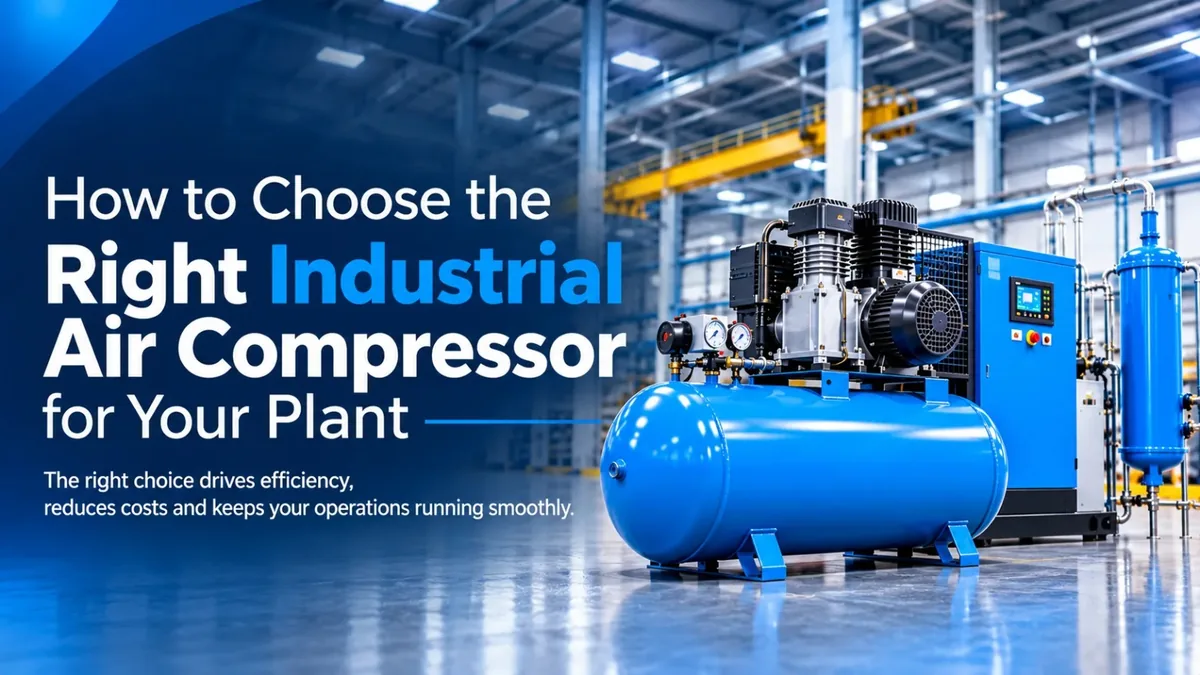
Choosing an industrial air compressor is not just about picking the largest machine or the lowest-priced model. The right compressor should match your plant’s actual air demand, working pressure, air-quality needs, duty cycle, and long-term operating cost.
A well-selected compressor improves uptime, reduces energy waste, and supports consistent production. On the other hand, a wrong compressor can lead to higher energy bills, production bottlenecks, maintenance issues, and unnecessary operating costs. That is why industrial air compressor selection should never be based on price alone.
The right solution must match your plant's air demand and goals. A properly sized and configured system delivers reliable performance, reduces downtime, and supports long-term operational efficiency.
So, how can you make the right choice? In today’s post, we will walk you through the key factors that can help you choose the right industrial air compressor for your plant. Let us begin.
- 01 What Is a Compressed Air System?
- 02 Why Is Compressed Air System Selection So Important?
- 03 What Are the Main Types of Industrial Air Compressors?
- 04 What Should You Know Before Selecting an Industrial Air Compressor?
- 05 How Do You Calculate Air Demand and Required Pressure?
- 06 What Role Do Air Dryers, Filters, Receivers and Piping Play?
- 07 Look Beyond the Purchase Price
- 08 Speak to the SiS Experts Today
1. What Is a Compressed Air System?
A compressed air system takes in air from the surroundings, compresses it to a higher pressure, and supplies it to machines and equipment that need it to operate.
But how does the compression actually work? When you compress air, you force its molecules into a smaller space. This results in increased density and makes the molecules move faster. The kinetic energy and temperature also increase. This is known as the “heat of compression”. In simple terms, you are storing energy in the compressed air so it can be used later.
Many industries use compressed air to run pneumatic tools, operate machinery, power automated production lines, and carry out everyday production tasks.
But a compressed air system is not just a compressor. It consists of several components that work together to make sure the air is available when and where it is needed.
- Air compressor: Takes in air and compresses it to the required pressure.
- Air receiver tank: Stores the compressed air temporarily to help meet sudden increases in demand.
- Air dryers and filters: Remove all the excess moisture and unwanted particles from the air.
- Pipes and distribution network: Transports compressed air to different machines and workstations.
- Control system: Helps the compressor adjust its operation based on the requirements
All these components play an important role in keeping the system running smoothly. A properly designed compressed air system ensures that equipment receives the air it needs at the required pressure and quality, while helping minimise energy waste and unplanned downtime.
2. Why Is Compressed Air System Selection So Important?
In a manufacturing hub, compressed air is often considered the fourth utility along with electricity, natural gas, and water.
It powers pneumatic equipment, supports automated processes, and keeps your production machines running smoothly.
However, generating compressed air requires energy and budgeting. Unlike these other utilities, compressed air is generally generated on-site using compressors and supporting equipment.
That’s why manufacturers always need to choose the right combination of equipment to meet their plant's air requirements.
A compressed air system includes more than just a compressor. It also needs air treatment equipment to remove moisture and contaminants, along with controls to manage how the system operates.
The main components of a compressed air system are:
Air treatment equipment: Refrigerated and desiccant dryers help control moisture, while suitable filters remove contaminants as per the requirements. Filters may also be needed to remove particles, oil aerosols, and other contaminants.
Compressor controls: The control system determines how compressors respond to changing air demand. Common options include start/stop, load/unload, modulating controls, variable frequency drives (VFDs), and lead-lag sequencing for coordinating across multiple compressors.
Choosing the right equipment helps to maintain consistent air pressure, reduce energy waste, maintenance expenses, and unexpected downtime.
On the other hand, an incorrectly selected system can waste energy, cause pressure fluctuations, and affect production.
That's why compressed air system selection should match the plant's air demand, operating pressure, air quality requirements, and future needs.
3. What Are the Main Types of Industrial Air Compressors?
Industrial air compressors come in different types, and each one is designed to meet specific goals.
| Compressor type | Best suited for | Key consideration |
|---|---|---|
| Reciprocating (piston) | Small workshops and operations with occasional air usage. | Works well when compressed air is needed in short bursts rather than continuously. |
| Rotary screw | Factories and production lines with regular air consumption | A popular choice for continuous or frequent industrial operation. |
| Variable speed drive (VSD) rotary screw | Facilities where air demand changes throughout the day | Adjusts motor speed to match air production with demand, which can reduce energy waste and match the demand. |
| Centrifugal | Large industrial facilities with high air demand | Suitable for large industrial plants that need a high volume of compressed air with consistent demand. |
In the end, the best option depends on your plant's actual load profile, required pressure, operating hours and budget.
4. What Should You Know Before Selecting an Industrial Air Compressor?
Before choosing an industrial air compressor, understand your plant's needs. The right choice depends on how much air your equipment needs, the pressure it requires, and how frequently the system will operate.
Here are a few things to consider before making your choice:
- Applications: Identify the machines, tools, and production processes that use compressed air. This will help you to understand where and how the air will be used.
- Operating hours: Check whether the compressor will run occasionally, during a single shift, or throughout the day. This helps determine the type of compressor that suits your operations.
- Air demand: Understand how much compressed air your plant needs and whether that demand stays consistent or changes during production.
- Air quality: Determine whether your application needs dry, filtered, or oil-free air. The required level of treatment depends on how the compressed air will be used.
- Future expansion: Think about your plant's future needs. If your production is expected to grow, choose a system that can accommodate higher air demand without requiring major changes later.
By assessing these requirements, you can select a system that meets your production requirements without unnecessary energy use or operating costs.
5. How Do You Calculate Air Demand and Required Pressure?
Choosing the right air compressor starts by understanding the air pressure goals required by your equipment. Accurate air compressor sizing for industry helps to maintain reliable performance while avoiding unnecessary energy costs.
Calculate the Total Airflow
Airflow generally tells you how much compressed air your equipment needs over a specific period. It is commonly measured in CFM (cubic feet per minute) or m³/min.
Start by listing all the machines, tools, and equipment that use compressed air. Check their airflow requirements and identify which ones operate regularly.
For example, if three machines each require 20 CFM and all three operate simultaneously, the total airflow requirement is 60 CFM.
However, this is only your base demand. You also need to consider air leaks, variations in production, pressure losses, and any planned increase in equipment. Instead of adding an arbitrary percentage to the total, assess these factors to determine the additional capacity your plant actually needs.
Accurate airflow calculations help you select a compressor that can meet production demands without unnecessary energy consumption.
Determine the required pressure
Pressure means how forcefully the compressed air will be delivered to the equipment. It is commonly measured in PSI (pounds per square inch) or bar.
Different machines may require different operating pressures. For instance, if a machine needs 90 PSI, make sure the system can supply that pressure.
Avoid setting the pressure higher than necessary, as this can increase energy costs.
6. What Role Do Air Dryers, Filters, Receivers and Piping Play?
A compressor does the main job of producing compressed air, but other components help ensure that the air is clean, dry, and delivered appropriately.
- Air dryers: Compressed air often contains moisture. Air dryers remove excess moisture to help prevent corrosion and protect equipment.
- Filters: Filters remove dust, particles, and oil aerosols and selecting the right filter grade helps to meet air quality requirements without causing excessive pressure drops.
- Air receivers: These tanks provide storage that helps manage short-term demand fluctuations and can reduce unnecessary compressor cycling. They can also reduce frequent compressor cycling when properly sized.
- Piping and distribution: Pipes carry compressed air to different machines throughout the plant. Properly sized pipes and leak-free connections can help to reduce pressure losses and energy waste.
7. Look Beyond the Purchase Price
A compressor with a lower upfront price may not always be the most economical choice in the long run. Electricity bills, regular servicing, and downtime can significantly increase the total cost of ownership.
Before making a decision, always ask for:
- Energy consumption at full load and partial load
- Specific power consumption, such as kW per 100 CFM
- Unloaded power consumption
- Service intervals and spare-part availability
- Noise level and installation footprint
- Warranty and after-sales support
- Remote monitoring and diagnostic features
8. Speak to the SiS Experts Today
The right air compressor for manufacturing should offer a perfect balance of capacity, pressure, air quality, energy efficiency, and serviceability. Instead of choosing based only on price or horsepower, evaluate the complete system: compressor, dryer, filters, receiver, piping, controls, and maintenance support.
At SiS, selecting a suitable solution starts with understanding the plant's application, operating conditions and compressed air requirements. Evaluating these factors helps identify the appropriate compressor capacity, technology and goals.
From expert guidance on air compressor sizing for industry and compressor capacity selection to advanced compressed air systems, our team helps you maximise efficiency, reliability, and long-term value.
Contact SiS today for expert consultation and discover how the right compressed air system can transform your plant's efficiency and operational success.
Frequently Asked Compressor Selection Questions
How do I calculate the capacity of an air compressor for a factory?
What information is needed before requesting a compressor quotation?
- Required airflow (CFM or m³/min)
- Operating pressure (PSI or Bar)
- Industry and application type
- Daily operating hours and number of shifts
- Air quality requirements
- Existing compressed air system details
- Available installation space
- Future production expansion plans